Wild About New Ash Green


New trees planted in the Meadow to support vulnerable butterflies.
Disease Resistant Elm trees
Following the success of Blossom Day and the planting of some new apple tree saplings in the Orchard, we have planted 10 disease resistant elm trees in the meadow. These new trees have been planted to support a colony of White Letter Hairstreak butterflies. There are some existing elms in the location on which the butterflies exclusively feed. Unfortunately, due to Dutch Elm Disease, these trees are not in good health and over the next few years are likely to be lost altogether. The knock-on effect across the country has been that White Letter Hairstreaks have suffered due the loss of elms. Now that disease resistant trees are available, we can attempt to strengthen the population of elms in the meadow and support the wildlife which depends on them. Now we are actively watering the elm saplings because of the dry Spring weather. All of the trees are growing well and appear to be in good health.
White Letter Hairstreak butterflies
White Letter Hairstreak butterflies are local to colonies where elms are present. They are small and can be easily overlooked. The adult butterflies may descend from the trees to feed on flowers, like wild marjoram, at the edge of the meadow. They always settle with wings closed and can be identified by a white letter ‘W’ shape on their hind wings. White Letter Hairstreaks have been reported in the meadow for several years. Last year, as far as we know, the first photograph was taken of one in the meadow. Adults will be on the wing in June/July. They have some legal protection in England under the Natural Environment and Rural Communities Act 2006.
Brown Hairstreak butterflies
Brown Hairstreak butterflies are a close relative to the White Letter Hairstreaks. They are locally a rare sight and until recently considered extinct in Kent. They do have a foothold, surprisingly, in parts of South London. Over the last few years, records have indicated that they are moving East out of London and settling in West Kent. One place they have been observed and have a growing population is Fackenden Down near Otford. Over the winter months searches have been conducted to find Brown Hairstreak eggs in local areas, projecting their movement eastward. The caterpillar food plant is blackthorn (sloe). We have blackthorn in the Meadow and in Northfield. Brown Hairstreak eggs were found on the Blackthorn in both locations. Very exciting! So, here’s another one to keep an eye open for. Slightly larger than the White Letter Hairstreak, they often sit with wings open. As the name suggests, they are brown in colour but with orange underwings. The females have an orange stripe on the upper forewings, the males have an orange dot.
Butterfly walks
The Woodlands Group plan to run a butterfly walk in the meadow and possibly other areas around the village toward the end of June. It would be great to have you join us. Keep and eye out on our Facebook group and Website for the upcoming date.

One of the ten disease resistant elm saplings planted in the Meadow

One of our own White Letter Hairstreak butterflies in the Meadow 2025

A Brown Hairstreak butterfly. Eggs have been found in the Meadow!
2025.
A very successful year for the Woodlands Group!
In January, we had our biggest and best ever wassail (only beaten by our wassail in 2026!) Thanks to all our volunteers for making it happen! We spent the rest of the month building dead hedges in the orchard and prepping the ground for the year of tree planting that lay ahead.
In February, we planted 10 new young apple trees - a range of varieties chosen for Hardiness. These were quickly adopted by some keen members of the woodland group, who were responsible for giving them a good start in life and plenty of water. This was particularly important given the dry summer to come! We also took good care of the older apple trees. In March a specialist pruned a number of them to increase their wind-resistance and longevity.
April brought our annual blossom day. We came together again to celebrate the trees and the coming spring, with guided tree walks and orchard games galore!
The hot dry summer meant lots of work keeping the new apple trees watered. Between sloshing barrels of water down to the orchard, we ran two guided wildflower walks in June.
Despite the drought, our butterfly walks had to be postponed due to wet weather in July! Keep an eye out for these walks this summer.
The wet weather meant that our annual cut of the wildflower verges, and subsequent hay making, was also delayed. In the end this was able to happen mid August, which is the earliest we’ve ever done it, due to the hot summer. we also cut some trial squares on the meadow, continuing an experiment started the year before, and transferred green hay from Rectory Meadow to see if we can introduce some additional wild flowers, including orchids.
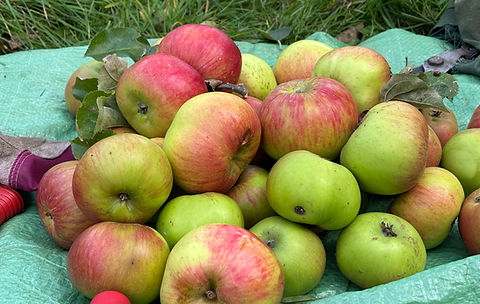
The autumn was full of apples! 2026 was a mast year, with a proliferation of orchard fruits. We couldn’t pick enough apples and ate many a pie, cake and crumble.
Overall a hugely successful year with 18 workdays and huge amounts of fruit to show for it! A huge thanks to everyone who gives their time.


February 2026
Beating the Bounds
Beating the Bounds is an ancient English tradition, often held during Rogationtide, where community members walk the perimeter of their parish to define and bless its boundaries. Participants, traditionally led by clergy and children, use willow wands to beat boundary markers, such as trees or stones, to ensure knowledge of these limits is passed down.
We are holding our own Beating the Bounds walk on 8th February. Meet outside the Royal Oak pub at 10am. the walk will follow the perimeter of the village. Prepare to be surprised by hidden areas that you may never have seen. Go to Events if you wish to RSVP.
Key Aspects of Beating the Bounds:
-
Purpose: Historically, this practice was vital for maintaining the knowledge of parish boundaries before modern mapping, ensuring boundaries were not moved.
-
Method: Participants walk the parish boundary line, stopping at landmarks to strike them with wands, and sometimes offering prayers for protection.
-
Traditions: In some areas, younger participants are "bumped" (had their heads or bottoms gently bumped) on boundary stones to firmly fix the location in their memory.
-
Occurrence: The event typically takes place around Rogation Sunday (the fifth Sunday after Easter) or Ascension Day.
-
Modern Day: While no longer strictly necessary for mapping, the custom is still observed in many parishes as a community-building event.
-
Example: The All Hallows by the Tower in London performs this ceremony, which includes a boat trip to mark the boundary in the Thames.

October 2025
An update on how the wildflower verges have fared over this long hot, dry summer plus some wildlife to look out for in the village this autumn.
There are 12 wildflower verges around the village and it’s fascinating watching how the different verges evolve. We sowed lots of native wildflower seed five years ago, but the really exciting thing is how many unexpected species have also moved in – “if you build it, they will come” definitely rings true in the world of wildflowers! On the guided walks we led in June we found early purple and pyramidal orchids had invited themselves into our wild patches. And alongside Field Scabious, Lady’s Bedstraw and Yellow rattle, we also found Fairy Flax, Centaury and wild carrot. Sticking with the old adage, we made hay while the sun shone in August – getting the verges cut and raked before the good weather started to break down. Our teams got stuck in and made light work of all the cutting and clearing.
It’s always a perfect time to enjoy New Ash Green’s wildlife. As autumn settles in, the village is alive with seasonal sights and sounds. Evenings echo with the rhythmic chirping of the Dark Bush Cricket, thriving in bramble and hawthorn hedgerows. Pause at dusk and their chorus will accompany your walk. Not all flowers are gone — Ivy blooms now provide vital nectar for late pollinators like the Peacock Butterfly and the Ivy Bee, which feeds solely on ivy. The village’s orchard and meadow also shine at this time of year. The hundred-year-old apple trees still bear fruit, a feast for thrushes — Fieldfare, Mistle Thrush, and Song Thrush. Look for them among the branches or feeding on fallen apples. Along woodland edges, they turn to bright hawthorn berries, adding splashes of red to the autumn landscape. Take a moment to slow down, notice the season’s shift, and share your sightings on Wild About New Ash Green Facebook group.


